



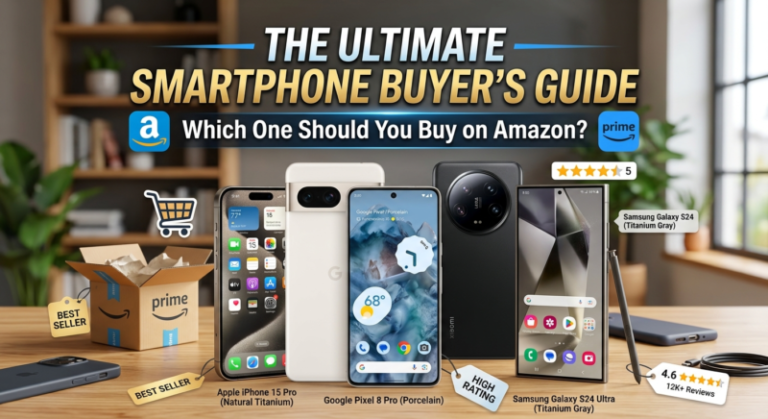
Finding the perfect smartphone on Amazon can feel like navigating a maze. With hundreds of options, flashy marketing specs, and wildly different price points, it’s easy to get overwhelmed.
Whether you are a mobile photographer, a hardcore gamer, or just looking for a reliable device that won’t break the bank, this guide is for you. We’ve broken down the top contenders on Amazon right now, followed by a foolproof buyer’s guide to help you make the right choice.
📊 Head-to-Head Comparison: The Top Contenders
Before diving into the details, let’s look at how the leading smartphones stack up against each other in key departments.
| Feature | The Premium Powerhouse (e.g., iPhone Pro / Galaxy Ultra) | The Value Flagship (e.g., Google Pixel / OnePlus) | The Budget Champion (e.g., Samsung A-Series / Moto G) |
| Best For | Ultimate performance, pro photography, prestige. | Incredible cameras, smooth software, smart pricing. | Battery life, everyday tasks, maximum savings. |
| Display | 120Hz LTPO OLED, Max Brightness | 120Hz OLED/AMOLED | 60Hz – 90Hz LCD/OLED |
| Camera Setup | Triple/Quad lens with Periscope Zoom | Dual/Triple lens with Advanced AI | Dual lens (Standard + Macro/Depth) |
| Processor | Top-tier (Apple A-Series / Snapdragon Gen 4) | High-end (Google Tensor / Snapdragon Gen 3) | Mid-range (MediaTek / Snapdragon 6-series) |
| Battery Life | 1 to 1.5 Days | 1 Day | 1.5 to 2 Days |
| Price Range | $1,000+ | $500 – $800 | Under $300 |
📱 Product Showdown: Which Tier Fits You?
1. The Premium Powerhouse (Flagship Tier)
Ideal for: Tech enthusiasts, content creators, and power users who want the absolute best.
If budget isn’t an issue, the flagship tier offers unmatched performance. These devices feature titanium or premium glass builds, displays that are easily readable under direct sunlight, and camera systems that can rival DSLR cameras.
-
Pros: Incredible zoom capabilities (up to 5x–10x optical), future-proof processing power, 7+ years of software updates.
-
Cons: Very expensive, bulky, usually doesn’t include a charger in the box.
-
What to look for on Amazon: Check for “Factory Unlocked” versions to ensure they work with any carrier.
2. The Value Flagship (The “Sweet Spot”)
Ideal for: The smart shopper who wants 90% of the flagship experience for 60% of the price.
This category has exploded in popularity. Brands achieve this price point by keeping the top-tier processor and main camera, but opting for slightly cheaper materials (like aluminum instead of titanium) or dropping niche features like wireless charging speed.
-
Pros: Exceptional point-and-shoot cameras, flagship-level speed, excellent value for money.
-
Cons: Shorter zoom range, slightly slower charging times than premium models.
-
What to look for on Amazon: Keep an eye out for Amazon “Renewed” (Refurbished) options here; you can often score a last-year flagship at this price point.
3. The Budget Champion
Ideal for: Kids, seniors, or anyone who just needs a phone for social media, calls, and banking.
Budget phones are no longer “cheap and laggy.” Today’s under-$300 phones offer massive batteries (often outlasting flagships) and perfectly crisp screens for streaming videos.
-
Pros: Incredible battery life, includes a headphone jack and expandable storage (microSD) often missing in flagships.
-
Cons: Plastic builds, slower performance in heavy 3D games, limited software updates (1–2 years).
🛒 The Ultimate Smartphone Buyer’s Guide: 5 Things to Consider
When scrolling through Amazon listings, ignore the marketing jargon and focus on these five core pillars:
1. Operating System: iOS vs. Android
-
Choose iOS (iPhone) if you already own an iPad or Mac, prefer a simple and uniform user interface, and want the highest resale value later on.
-
Choose Android if you love customizing your home screen, want more hardware variety (like folding phones), and prefer a universal USB-C ecosystem across all tiers.
2. Display Quality (Refresh Rate Matters)
Do not just look at the screen size. Look for the Refresh Rate.
-
Standard phones use 60Hz.
-
Mid-range and premium phones use 120Hz.
A 120Hz screen refreshes 120 times per second, making scrolling through social media and animations feel incredibly buttery smooth. Once you use 120Hz, it is hard to go back.
3. Battery Life & Charging Speed
A big battery capacity (measured in mAh) is great, but software optimization matters too.
-
Look for a minimum of 4,500mAh to 5,000mAh for Android devices.
-
If you are constantly on the move, check the Wired Charging Speed (W). Flagships charge anywhere from 25W to 45W, while some value brands offer up to 80W+, juicing your phone from 0% to 100% in under 40 minutes.
4. Storage Space: How much do you actually need?
-
128GB: The bare minimum. Good for casual users, but will fill up fast if you shoot 4K videos.
-
256GB: The “Sweet Spot.” Plenty of room for apps, offline Spotify playlists, and years of photos.
-
512GB/1TB: Only necessary if you shoot professional video or download heavy mobile games.
5. Amazon-Specific Tips: How to Avoid Scams
-
Check the Seller: Ensure the listing says “Ships from Amazon” and “Sold by [Brand Name]” or “Amazon.com”. Avoid third-party sellers with low rating percentages.
-
Check the Network Compatibility: Always look for “Factory Unlocked US Version” if you are in the US, or global versions depending on your region. Make sure it explicitly lists support for your carrier (e.g., T-Mobile, Verizon, AT&T).
-
Read the 1-Star and 4-Star Reviews: 5-star reviews can sometimes be inflated, while 1-star reviews reveal common defects. 4-star reviews usually give the most honest pros and cons.
🏁 The Verdict: Which should you add to your cart?
-
If you want the ultimate camera and don’t care about price, go for the Premium Powerhouse.
-
If you want the best bang for your buck with a stellar camera, add the Value Flagship to your cart.
-
If you just need a reliable device with a battery that lasts two days, save your money and grab a Budget Champion.